Promised Land: an interview
KS: To find the character of a place is a paradoxical task, and one could argue it is impossible to accomplish in any objective sense since, not only is the character always subjective, it is also ever-changing. Still, it is an interesting problem to pose nonetheless. I had to ask myself, before I even took any photographs, can a place even be defined in this way? I know it's done all the time-everywhere people characterize their experiences of a place and say, "Yeah, this is London," or "This is Detroit," or Kabul or New York. But what is really going on? A tourist in town might have a checklist of sites to see and after viewing them feel they have "been there." Have they? On the face of it I would say absolutely not. And yet, in some way, while dutifully going down that checklist, one might have an experience, some kind of unique, personal experience that fixes in their mind the idea that they know something about a place. What they know is their experience and the relationship that they developed to their experience in combination with whatever other knowledge they have about the place. In total, this gives them a belief they can describe the character of a place. So, in a sense, any experience someone has in a place begins the process of drawing a picture of what that place signifies for him or her. And any experience will do. But are they the right kind of experiences to know the particular character of a place? Who is to tell? This is the paradox. There is no right answer and I will never arrive at some objective truth as to what the "true" character of what Groningen is, or of any place for that matter. I will only have my impressions based on what I saw. What I see depends on thoughts I have at the time interacting with the reality I encounter. People and things exist in a particular time and place and I may notice them-or not. But my experience and the work that results are, by definition, anecdotal, anyone's are. Now, as I am an outsider not from this place, or this continent even, life in Groningen is something of a mystery to me, and you could even say it is exotic to me. On the surface, much is similar to life in other places, but there are many differences. I chose to look at a relatively mundane thing: the comings and goings of people in mostly public spaces-I looked at what they wore and how they interacted as they commuted or shopped-in a word-what they were doing when they were doing nothing. I chose to work in this way, because I wanted to strip out the specificity of what people do. I wanted to find out if it was possible to see what lies
underneath. I played with transparency
and looking through things as a metaphor for the transparency of a place. In
the end, I still wonder if seeing is knowing, or if seeing only deepens the
mystery of the "other."
MN:
How did you experience Groningen and its inhabitants yourself, apart from the
assignment? How does it differ from the America you know?
KS: I don't know if
I could say what my experience was apart from the assignment, as it is all of
a piece. The part when I was taking pictures are different only because I can show you what I
saw, give you a visual reference to what I was thinking. I do distinctly remember,
at the time, that America was about to invade Iraq. There was a lot of tension
in New York around the treat of terrorism. I was quite frustrated with how
New York, at least, was shutting down a part of its public aspect. You couldn'tjust walk into places anymore, such as office buildings. Municipal government set up metal detectors at the entrance to their buildings and City Hall was cordoned off to the public completely, with sentries carrying automatic weapons. So I was very relived to get out and be in another place. I was eager to see a society that isn't in the middle of this craziness, that isn't in the process of shutting itself down so completely. Living in a country that thinks itself as-and is largely perceived to be-the lone superpower in the world is a heavy burden for its citizens, whether or not they realize it. It was a breath of fresh air coming to Groningen. I was excited to go into every nook and cranny and see what I could see. I remember, the first day my interpreter/aide asked me what I would like to do, where I would like to go. I randomly pointed to a houseboat on a canal. We went onboard and just started taking pictures. Then we were invited inside by the owners to take more pictures. Having just come from New York, this was a revelation to me. People just didn't invite you into their homes like that, especially after finding you poking around the premises. In the end, my working title for my contribution to Promised Land was "An Absence in the Presence of Things." While I was invigorated by this openness, and my ability to look at everything, I felt that people in Groningen were shut off from the special quality of their own reality. As the assignment prophesized, I got to see things "so common that even the inhabitants hardly notice them
anymore." I
would argue that people everywhere are blind to their own reality. I happen
to have made these pictures in Groningen.
MN:
Could you tell something about your background as a photographer and about your
work?
KS: I have been photographing for about 26 years. I picked it up in college
where I was studying painting. It was an eye-opener for me because I could
turn the camera toward the world and ask questions. I felt I was unable to
do that with painting. When I first started I worked as a photographic printer for Gilles
Peress who introduced me to some of the Magnum photographers. At the time
I was living in the East Village, and I saw that world transform. It was
there that I did my first book, Invisible City published by Twelvetress Press
in 1988. I continued to work on book projects questioning my personal and
ethical relationship to the world. In 1999 Noorderlicht premiered my 12-year
project on violence called The Geometry of Innocence, and this led to its
publication by Hatje Cantz in 2001. My work has been exhibited internationally
and garnered awards. This past May I had quite a bit of fun exhibiting a book at the FOAM (Fotomuseum Amsterdam), which is a comprehensive history
of photography with only my photographs. It uses the trope "Language speaks
us as we speak language," by Heidigger as its conceit. At Noorderlicht's
Traces and Omens exhibition I'll also be premiering an unpublished book project
called "Homeland Security," which looks at a post 9/11 America.
...
read reviews on this body of work. See the following articles in:
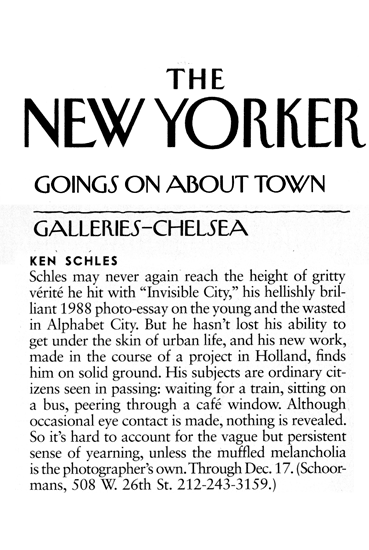
The New Yorker
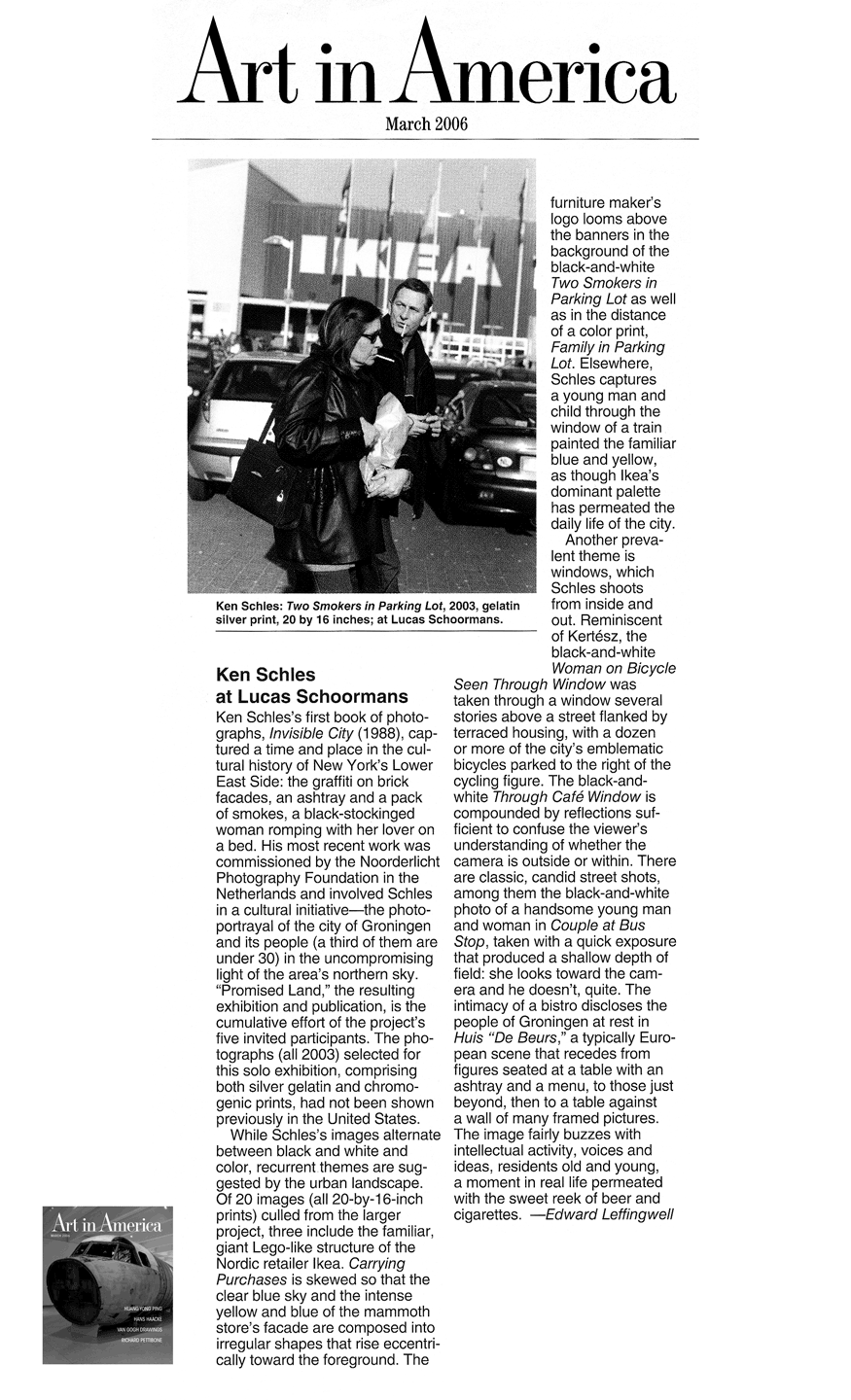
Art In America
see all reviews.
– / back to books